

How to calculate the net return on a rental
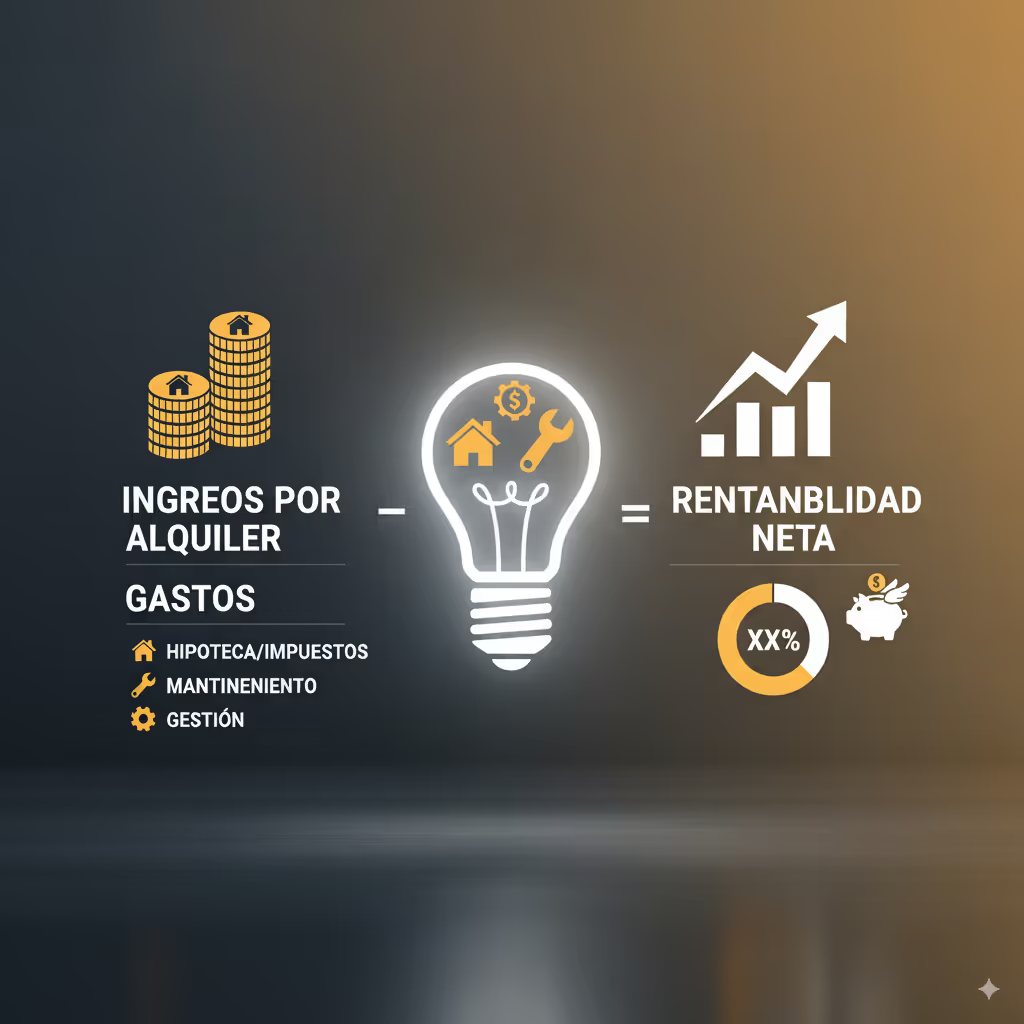
TL; DR: Net return measures the real return on your rental after subtracting all expenses from income and dividing the profit by the total investment. Base formula: Net Return (%) = [(Annual Revenue — Annual Expenses)/Total Investment] × 100. Start with gross profitability as a filter, incorporate all costs (IBI, community, insurance, maintenance, management, interest, vacancy) and compare. In personal income tax there are deductible expenses and reductions for regular housing contracts.
The net return formula (step by step)
Before drawing numbers, it is important to differentiate Brute and Granddaughter. The gross return serves as a quick estimate; the net value reflects what you actually have left after subtracting all the costs associated with the property. Calculating both allows you to compare opportunities wisely and avoid cash surprises. If you want to dive deeper into metrics, here's what they mean ROI, IRR or IRR in real estate.
1) Annual rental income
Multiply the monthly rent by 12. If you expect tenantless months, add a provision of Vacancy (for example, one month a year equals 8.33% of income).
2) Annual expenses
Add up all the costs directly linked to the property: local taxes (IBI, garbage), community, insurance, maintenance and repairs, management, interest and any other expense necessary to obtain the rent. The Tax Agency details what items are deductible and with what limits in its guide to deductible expenses.
3) Total investment
It's the purchase price Plus the acquisition costs: taxes (ITP/IVA), notary office, registry, management, valuation and, if appropriate, initial reform necessary to be able to rent.
4) Gross and net calculation
- Gross return (%) = (Annual Revenues/Total Investment) × 100
- Net Return (%) = [(Annual Revenue — Annual Expenses)/Total Investment] × 100
Fixed (and recurring) expenses to consider
After the first gross calculation, the actual result depends on correctly identifying everyone the expenses you bear as a landlord. Many are deductible in personal income tax if they meet the requirements of the Tax Agency; in addition, there is the amortization of the property and of the assets transferred with specific rules. I'll summarize the most common ones and where to compare them.
Taxes and tributes
As an owner, you will normally assume the IBI, the Waste rate and other local tributes. For the purposes of your profitability, calculate what you actually pay, regardless of what was agreed with the tenant.
Community, Insurance and Services
includes community expenses ordinary and possible spills, home insurance and, if you hire him, default insurance. Los supplies they are usually borne by the tenant for long-term rentals, but if you assume them, add them to the calculation.
Maintenance and repairs
Book one annual provision for maintenance and minor repairs (painting, appliances, minor plumbing). These games are deductibles as a maintenance and repair expense. Instead, the improvements they are not deducted as an expense of the year: they increase the amortizable value of the property. The regulations are detailed in the guide to Tax Agency deductible expenses.
Management and brokerage
If outsourced the merchandising and/or the stewardship of renting with an agency, includes your fees. Fixed-rate models or a percentage of income are common.
Funding
It incorporates the interests and other mortgage financial expenses. They are deductible with limits and rules linked to the full performance of the property. Check the details in the Tax Agency: deductible expenses.
Vacancy and defaults (provision)
Add a provision for months without a tenant And Defaults. It is not an “accounting expense” in personal income tax, but it is a prudent way to obtain a realistic economic photograph.
Practical example with illustrative numbers
This example is didactic to understand the method; it does not reflect market averages. Adapt it to your case and contrast each figure.
- Purchase Price: 150,000€
- Acquisition costs: 12,000€
- Total investment: 162,000€
- Monthly rent: 900€ → Annual revenue: 10,800€
- Mortgage interest (year): 2,100€
- Community: 70 €/month → 840 €/year
- IBI + rates: 550 €/year
- Home insurance: 220 €/year
- Maintenance (provision): 1,000 €/year
- External management (5% of income): 540 €/year
- Estimated vacancy: 1 month/year → 900€
Option A: Treat vacancy as a lower income
Income per occupation: 10,800 — 900 = 9,900€
Expenses: 2,100 + 840 + 550 + 220 + 1,000 + 540 = 5,250€
Annual benefit: 9,900 — 5,250 = 4,650€
Gross return: 10,800/162,000 × 100 = 6.67%
Net return: 4,650/162,000 × 100 = 2.87%
Option B: Treat vacancy as an expense (provision)
Annual revenue: 10,800€
Expenses: 5,250 + 900 = 6,150€
Annual benefit: 10,800 — 6,150 = 4,650€
Net return: 2.87% (identical to case A)
Interpretation: with these assumptions the net margin is adjusted. To improve it, either you increase takings (price/occupancy) or you reduce outlays (funding, community, maintenance, management).
Net return vs gross return
The gross is a useful first filter, but it ignores taxes, community, maintenance, funding and management. The net, on the other hand, shows the real capacity to generate cash of the property and allows you to compare blocks to blocks between cities and types. Therefore, it is advisable to calculate both and use the net to decide, adding a tax estimate when appropriate. If you need market context by area, consult the best cities in Spain to invest in housing (2025).
Recommended Use Metric/CalculationBrutaAnnual Revenue/Total Investment × 100Quick pre-selectionNet (before personal income tax)(Income — Expenses)/Total investment × 100Evaluate real asset performanceNet (after personal income tax)(Benefit - IRPF)/Total investment × 100Final return for the owner
Rental taxation: deductibles and reductions in personal income tax
Home rental income is taxed as returns on real estate capital. The regulations make it possible to deduct Necessary expenses to obtain the rent and practice the amortization of the property and of the assets transferred. In addition, there are reductions on positive net return for primary housing contracts depending on the type of contract and certain circumstances. It is advisable to review the Tax Agency manual every year and, if necessary, consult an advisor.
Key points to be tested in the Tax Agency:
- Deductible expenses: interest and financing expenses; non-state taxes (IBI, garbage); insurance premiums; maintenance and repair costs (not improvements); legal defense; amortization (general rule of 3% per year over the higher acquisition cost or cadastral value of the construction, excluding land, proportional to the time rented).
- Reductions: current regime with reduction Overall of 50% for regular housing and higher percentages under conditions (for example, contracts in tense areas with a reduction in rent compared to the previous contract, rent to young people in a tense area, social rent or rehabilitated housing).
In addition, if you are just starting out or looking to optimize your portfolio with a limited budget, here is a direct guide to How to invest in real estate in Spain with little money.
What is considered a good net return?
There is no universal figure. Depends on locational, risk, condition of the property, level of management and Time horizon. As a reference, several industry guidelines consider reasonable net returns starting at intermediate levels and always compared to alternatives of similar risk. To provide context and expectations, review these informative analyses of Prinex and BBVA. If you want to refine qualitative criteria, this article helps you define What is a good real estate investment.
Influencing factors (and how to optimize them)
Beyond the formula, net profitability depends on operational decisions and the market cycle. Identifying these levers will help you improve your final percentage without taking unnecessary risks.
- Location and demand: areas with stable demand reduce vacancy and turnover.
- Purchase price vs. potential income: a better purchase price has a greater impact on the net than marginal increases in income.
- Tenant quality: good filtering reduces defaults and legal costs.
- State of the property: reforms with clear ROI (bathroom, kitchen, energy efficiency) increase income and reduce maintenance.
- Management: outsourcing takes away your own time, but adds cost; compare it to your operational capacity.
- Funding: type and term affect interest (deductible) and cash flow; review conditions and alternatives.
- Occupancy strategy: traditional versus other modalities; remember that Stormy or touristic does not access regular housing reductions in personal income tax.
Invest without complication: Reental does it for you
If you don't want to spend hours collecting data, calculating vacancies, negotiating with suppliers, supervising repairs and adjusting taxation, Reental makes it easy for you. Our team selects and manages assets with professional criteria, centralizes documentation and monitoring in a single panel, and allows you to diversify without the operational burden of everyday life. You focus on deciding where to invest, while we take care of the management so that your potential returns are not dependent on crude tasks or unforeseen operational events. Do you want to see how it would work in your case? Find out how to invest with Reental.
Conclusion and next steps
Calculate the net return it's not just applying a formula: it involves measuring rigorously, comparing alternatives and deciding with all the costs on the table. Start with the gross, move on to the net by incorporating all expenses (including a vacancy and maintenance provision) and, finally, estimates the impact of PERSONAL INCOME TAX With the deductible expenses and reductions in force. To validate your assumptions, use a reliable calculator such as Fotocasa and contrasts the fiscal criteria in the Tax Agency. If you are looking for a less operational and more efficient approach, consider investing through Reental, real estate investment platform
Keep exploring about real estate investment: